Thursday, February 23, 2012

Day 1 (Market, Royal Palace, National Museum, Cyclo Tour, Sunset Cruise on Mekong)


Day 2

While yesterday was frivolous and fun, today was serious and contemplative. Though yesterday's tours of Phnom Penh's temples and markets weren't an inaccurate representation of Cambodian culture, we spent today educating ourselves about the darker elements of Cambodia's past and present.

In the morning, we visited the Cambodian office of the Somalay Mom Foundation, an organization that rescues victims from sex trafficking in Phnom Penh, educates and councils them, provides them with free healthcare, and generally prepares them for a healthy and independent life. We spoke with several women who survived and escaped the world of human trafficking, with assistance from the Somalay Mom Foundation.

I could detail the stories we heard or the facts we've learned, but that wouldn't properly communicate the reality of our experience. As several of us said as we were thanking the young women, talking about sex trafficking in an analytical way deprives the listener of the reality of these stories. I think it's safe to say that we all felt the true impact of the human trafficking epidemic in Cambodia, thanks to the brave survivors who shared with us this morning. Somalay Mom is fighting an uphill battle, but it's truly a worthwhile one.

Our next stop was Tuol Sleng, former school turned Khmer Rouge prison. One could walk directly into different cells, practically untouched since the fall of the Khmer Rouge. As Sabine and I discussed on the benches after our self tour, this was the most raw genocide museum we had ever experienced; when you were inside one of the cement-walled rooms, looking at the original torture devices, it felt as though the Khmer Rouge had fallen just yesterday. One can't the full magnitude of Pol Pot's regime without a visit to a site like this.

The next visit followed that same theme. We drove to Choung Ek, Cambodia's most well-known killing field on the outskirts of Phnom Penh. Again, we self-toured at our own pace. I began with the memorial in the center of the site, commemorating the approximate 9,000 people found dead at this killing field's mass grave. Then I followed the dirt path around the site, reading the signs that detailed the daily function of the field during the Khmer Rouge rule. One particularly shocking moment was passing by what's known as "The Killing Tree," at which Khmer soldiers killed the babies of prisoners. Again, the reality of Pol Pot's rule wasn't truly impressed upon me through the book we read or the packets we were given; seeing the location of some of the Khmer's atrocities hit it all home.

Luckily, our night activity was a relaxed one, which allowed us some time to process. We watched a dance performance from a Cambodian Living Arts troupe, complete with live music and ornate costumes. It definitely reminded us of the beauty of traditional Cambodian life. Though Pol Pot and his regime forever tainted the history of the country with tragedy, and the sex trafficking epidemic continues to undermine Cambodia's beauty, CFA and its productions are a testiment to hope and beauty in Cambodia.

Kate (H.)

Wednesday, February 22, 2012

Day 1!

After a whole day of Phnom Penh site seeing, I don't know where to start. Let's just say, it has been absolutely amazing, mind-blowing, and eye-opening.

I woke up early in the morning to the sounds of the bustling city below--it took a moment for me to remember where I was. After a western style breakfast, our lovely chaperones took us on a impromptu tour of the nearby market. The Cambodians start their day early in the morning. At 7 a.m., the vendors were all set up and ready to go for the day. Our first true taste of Cambodia, the tour of the market was already too much to take in. Endless was the variety of foods being sold. One woman chopped the head of a catfish, while another seller was busy tending to their fruit.

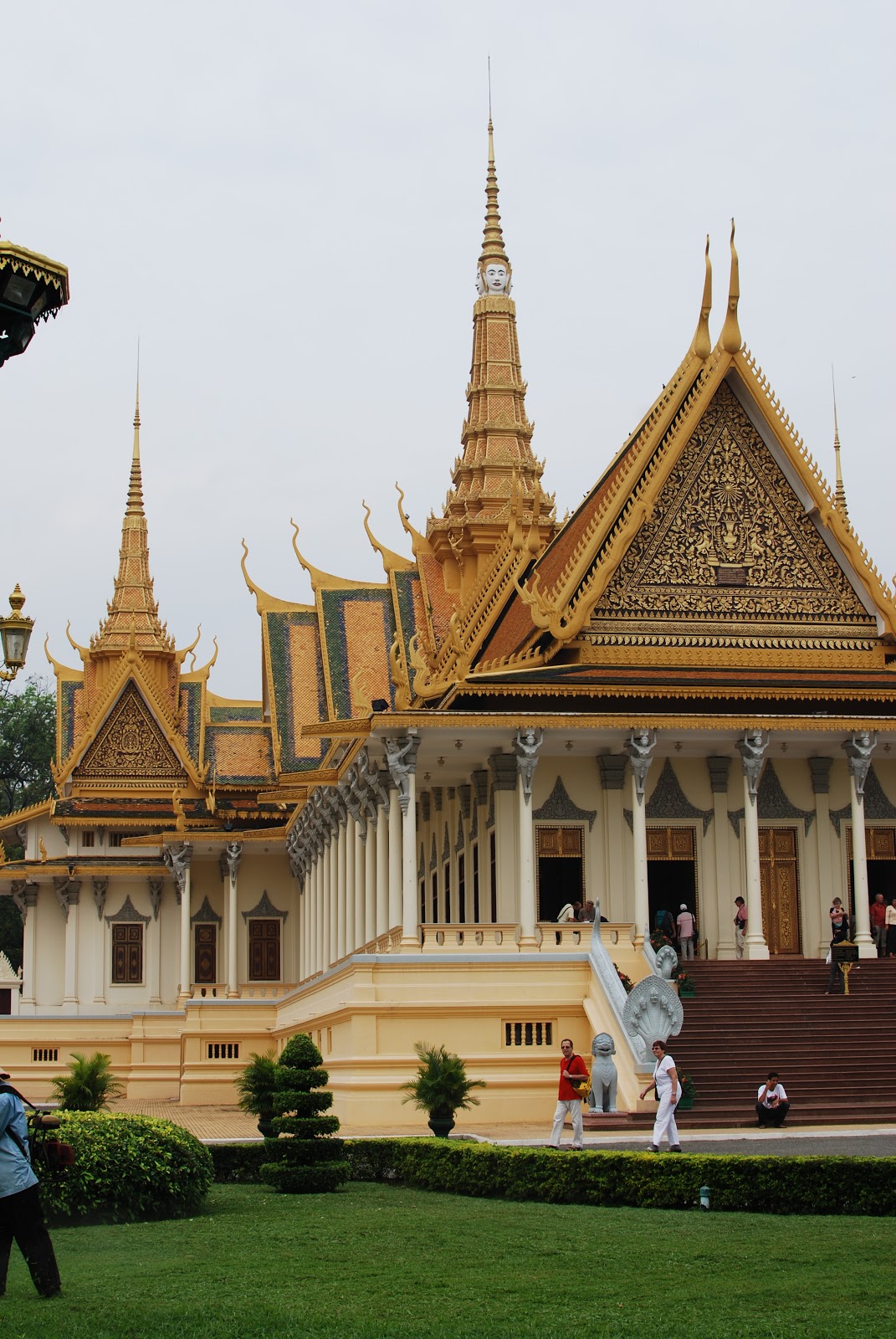
After breakfast, we met our tour guide/ translator, Lika. Our first stop was the Royal Palace, the residence of the current king and revered figure King Sihamoni. The extensive compound was breathtaking and gave the visitor a tangible idea of the rich culture and wealth the land of Cambodia possesses. The architecture alone told the fascinating story of the nation. A mixture of Hindu, Buddhist, and French, the buildings of the compound reflected the history of colonization in Cambodia. Where one could really understand the wealth of the land of Cambodia was the Silver Pagoda. The tiles of the house of worship each weigh about 1 kilo of silver. The pure gold statues were adorned with gleaming diamonds of impressive size. I personally am not a religious person, but being inside the Silver Pagoda turned out to be an out of body experience.

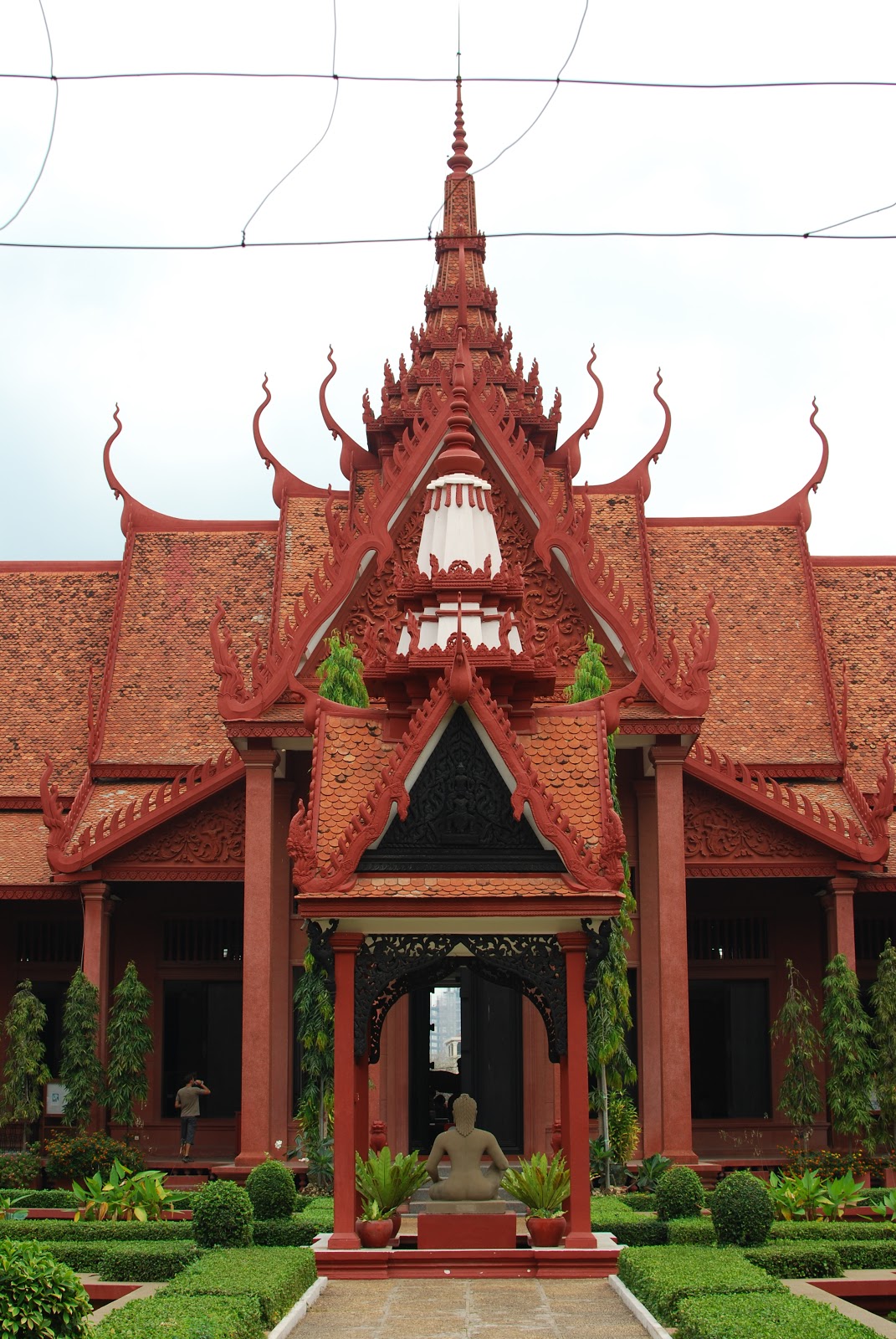
The nine of us traveled to our next stop by our tour bus which could probably fit twenty people. The National Museum, besides being a wealth of knowledge of Cambodian ancient art, also houses the largest bat colony in a public building. I didn't end up spotting any because most reside above in ceiling in the attic. The museum with an impressive collection of Khmer art provided a glimpse into the rich history of the complex empire.

For lunch, we ate at a nearby restaurant called Friends which is partnered with an NGO working with Cambodian street children, their families and communities to create creative projects that will help successfully integrate them into society.

We traveled the next leg of Day 1 by CYCLO--a fascinating vehicle. Basically, it is a bicycle with a basket seat for one person in front. Our friendly cyclo drivers brought us to the post office to pick out postcards. Afterwards, we stopped at the central market where you could find virtually anything--street foods, clothes, jewelry, bath products, anything.

At Wat Phnom, the Buddhist temple built by Lady Penh, we had our fortunes told. Inside one of the rooms of the temple, we were instructed to wish for good luck and then to shake a can of sticks until a single stick fell out. The numbered sticks indicated the your luck. I got the number twelve which meant good luck! Sabine, on the hand, had pretty bad luck. The shook the can four times and could not manage to receive a good fortune. After the fourth time, the fortune teller instructed Sabine to wash her face with holy water to cleanse herself of bad luck. In the main room of the temple, another man handed what looked like giant lima bean halves to Sabine. She had to drop them so one was face up and the other face down. In her third attempt, she succeeded!

The Independence monument was next on our list. A massive lotus shaped stupa in the center of a bustling rotary, the monument was daunting and a bit overwhelming to glance at. We took pictures with our cyclo drivers who were eager to get in the shots.

We rode along the beautiful river front, cooled by the breeze, a nice break from the oppressive humid 90 degree weather. Our next destination was a visit to the bridge where 351 people died in a stampede during a popular Cambodian water festival. A newly built bridge eerily contrasted the nearby remains of the bridge where the incident occurred. This was just one of the many examples of the mixture of old and new in the city of Phnom Penh.

We ended our day of site seeing with a sunset cruise on the Tonle Sap and Mekong River. Boat houses and fisherman boats lined the  banks of the river. Sitting with our feet dangling above the water at the bow of the boat, the magnificent sunset was a perfect ending to our day in Phnom Penh.

For dinner, we ate at Khmer Surin where Rohan ordered mackeral fish paste with fresh vegetables. The waiter warned Rohan of the pungency, but he not ready to back off. It ended up not being too bad.

That's all for now!

Yijin

Thursday, February 16, 2012

Student Research Topics

Each student participant has chosen a research focus he or she wants to explore further while in Cambodia and upon our return to the United States.  The goal is to have each student explore in depth an issue they interested in and passionate about.  Upon return, students will have the opportunity to share their learning with the Brookline Community.

Monday, February 13, 2012

Yijin's Research Topic

For my topic of research, I have chosen to focus on women in Cambodian society before and after the Cambodia Genocide. The plight of women in third world countries has always been a topic that I have been interested in. During this trip, I hope to explore in depth the workings of the Khmer social hierarchy and where women fit in the system. I am especially looking forward to learning more about the educational opportunities of Cambodian women, involvement in politics and the issue of sex trafficking.

While visiting the different historical genocide memorials and museums, I hope to investigate the status of women in Cambodian society under the rule of Pol Pot. Has the status of women improved at all in the past few decades?

I am especially excited to visit the Harpswell Foundation and to speak to the women who benefit from the organization. The dormitory and leadership center for college women in Phnom Pehn houses women who come from rural areas to attend university in the city. They have been selected on the basis of intelligence, ambition and leadership potential. I am interested to hear their visions for the future of women in Cambodia and the country itself.

Thursday, February 2, 2012

Environmental Affects of Bombings in Cambodia

For my topic of research, I've chosen to focus on the environmental impact of the American bombings in Cambodia. It's something I've always been interested in: whenever we discussed bombings of country or another in my history classes throughout the years, I wondered how many habitats the bombings destroyed, how many animals they killed, and how long it would take for the particular area to rebound. And it's speculated that Cambodia is the most-bombed country in history, so the environmental impact is most likely staggering.

Additionally, this question is particularly relevant to Cambodia, whose beautiful flora and fauna (in some ways, similar to that of Thailand) would be ripe for a flourishing tourism industry. This topic will certainly be a challenge: very little research as been done in this area, and it's unknown exactly how many bombs were dropped. The United States has little incentive to discover just how much destruction we caused there, and Cambodian-based NGOs have enough on their hands. But I'll do my best with the information there is, and I'm excited to tackle this topic.

Kate (H.)